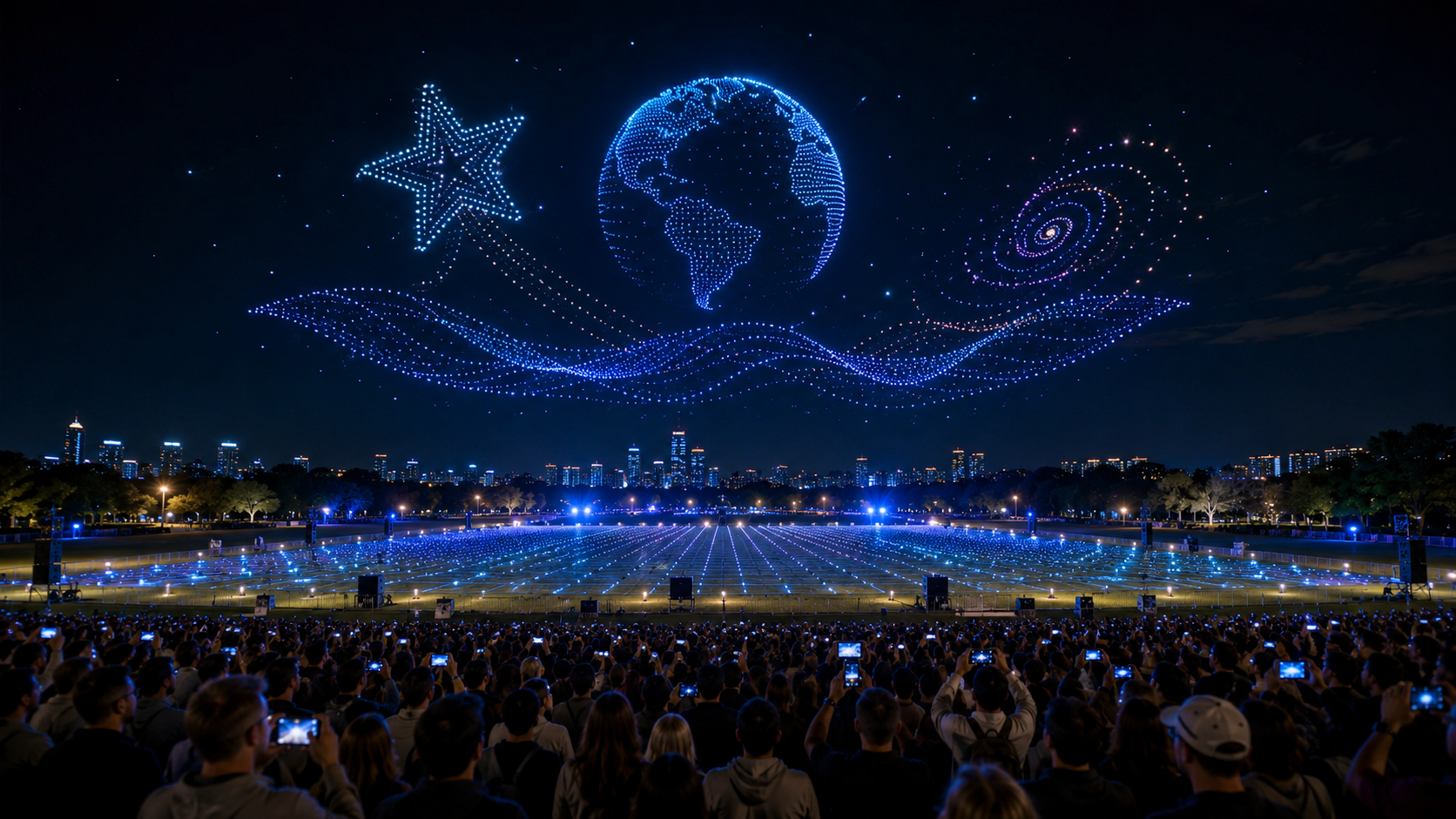
Drone Shows Are Replacing Fireworks and Rewriting the Rules of the Sky
The fireworks finale has anchored outdoor events for generations, but a quieter, stranger spectacle is steadily taking its place. Across festivals, stadiums, and city celebrations, swarms of hundreds of tiny LED-equipped drones now rise into the night sky, choreographed to form glowing logos, animated flags, and three-dimensional shapes that no pyrotechnic could ever produce. For event organizers, the appeal is obvious. Drone shows leave no smoke, start no wildfires, spare the neighborhood pets and veterans from the bang, and produce exactly the kind of shareable footage that spreads across social media. But trading gunpowder for flying robots over a packed crowd introduces a whole new category of risk, and an evolving thicket of rules that every organizer now has to navigate.
To understand the safety question, it helps to understand how these shows actually work. Each drone functions like a single pixel in the sky. A designer first creates the visuals, then specialized software translates that animation into an individual flight plan for every aircraft, telling each one precisely where to be and when to switch its lights on and off. Normally a single pilot controls a single drone, but that is obviously impossible when five hundred of them are aloft at once, so operators secure specialized authorizations that let a small team of five to ten people supervise the entire automated fleet. The drones fly themselves, following the choreography, while humans monitor for trouble.
The central safety concern is simple to state: what happens when one of these machines fails? The technology is not perfect, and the people who run these shows are candid about it. A drone might fail to launch, leaving a noticeable gap in the picture, or worse, a battery could die mid-flight and send the aircraft tumbling out of the sky. These drones weigh only a couple of pounds, but a couple of pounds falling from hundreds of feet carries enough energy to seriously injure someone. A mid-sized drone dropping from that height can hit the ground with thousands of newtons of force, which is precisely why aviation authorities treat any drone in flight as a high-velocity object rather than a toy. A malfunctioning unit can also collide with its neighbors and cascade into the rest of the formation, disrupting the whole show.
The industry’s answer to this is built on a foundation of physical separation and automated failsafes. The single most important rule is distance. Guidelines require the audience to stay back from the launch zone by a horizontal distance at least equal to the flight altitude, so a show flown at four hundred feet keeps spectators at least four hundred feet from the takeoff area. This creates a buffer zone, a calculated fall radius where a dropping drone lands on empty ground rather than on a person. Around the launch and landing area itself, operators establish a marked perimeter staffed by trained crew that no unauthorized person may enter. Layered on top of this geography are the technical safeguards: each drone is programmed with failsafe responses so that if it loses its GPS signal, suffers a battery problem, or receives an abort command, it is instructed to land itself safely in a designated recovery zone rather than fly off unpredictably. Many systems wrap each aircraft in a virtual safety bubble and use geofencing to prevent any drone from straying beyond its assigned airspace, with collision-avoidance running independently of the main choreography as a redundant layer. Before anything leaves the ground, the whole show is run in simulation and every drone passes a pre-flight diagnostic on its battery, motors, and communication links.
None of this is left to the operator’s good intentions, because the regulatory framework has tightened sharply. In the United States, every drone show requires coordination with the Federal Aviation Administration. Pilots must hold remote pilot certificates, and the operation runs under specific waivers that authorize flying many drones at once and, crucially, flying over people, which is otherwise restricted by default. Operators file flight notices and secure temporary flight restrictions over the event, effectively turning the airspace above the show into a no-fly zone for everyone else. The penalties for ignoring these rules have grown teeth: aviation regulators have raised fines for unauthorized flights over crowds into the tens of thousands of dollars per violation, and have begun suspending and revoking the licenses of operators caught committing safety violations during light shows. The legitimate companies expect to be asked for proof of certification and comprehensive aviation liability insurance, and they provide it without hesitation.
The pressure is only increasing as the technology spreads. Regulators are moving toward letting venues permanently restrict their own airspace, and new laws are granting local police the authority to detect and bring down unauthorized drones near stadiums and parks, driven partly by thousands of rogue drone incursions over major sporting events and the looming challenge of securing huge international tournaments. The sky over a crowded venue is becoming actively managed territory.
For event organizers weighing the switch, the calculus increasingly favors drones despite the complexity. The shows cost roughly what a quality fireworks display does, but without the permitting, the cleanup, or the fire risk, and they draw measurably more first-time attendees who come specifically to see the novelty and stay to record it. Booking requires real lead time, often a couple of months, partly because waiver processing alone can take several weeks. But the trade is compelling: an organizer swaps the established hazards of explosives for a managed, programmable, and genuinely safer alternative, provided it is run by professionals who respect the rules.
That last condition is everything. A drone show is breathtaking precisely because it is precise, and that precision is what keeps a crowd safe. The spectacle in the sky depends entirely on the discipline on the ground, the distances measured, the waivers filed, the failsafes tested, and the insurance secured. Get those right, and the fireworks finale of the future is one where nothing falls, nothing burns, and the only thing left behind is the video everyone is already sharing.